


In logistics, manufacturing, and transportation, on-time delivery is everything. It’s not just about moving goods — it’s about trust, customer satisfaction, and profitability.
But behind the scenes, operations teams spend countless hours doing something that doesn’t move a single truck or product: manual data entry and paperwork.
Dispatch coordinators manually log delivery details in SAP or Excel.
Warehouse staff type shipment IDs into portals.
Admin teams reconcile invoices and delivery confirmations.
This administrative overload causes bottlenecks, slows decision-making, and often leads to missed delivery windows.
That’s where automation — especially RPA (Robotic Process Automation) and AI-driven workflow automation — is changing the game.

Let’s look at the daily reality of a logistics or trucking operation:
| Process | Manual Pain Point | Impact |
|---|---|---|
| Order Entry & Dispatch | Staff manually enter order details into SAP or TMS | Delays dispatching by hours |
| Work-Order Creation | Human validation and double data entry | Increased processing time |
| Fuel & Route Logs | Manual updates from drivers | Data inaccuracy and late insights |
| Invoice & POD Validation | Manual reconciliation between systems | Slower billing cycle |
| Inventory Updates | Paper-based tracking of parts and materials | Missing or outdated stock data |
Each of these steps may only take a few minutes — but across hundreds of daily operations, it adds up to hours of wasted time and missed efficiency targets.
Automation in logistics doesn’t mean replacing people — it means removing repetitive, error-prone tasks that slow them down.
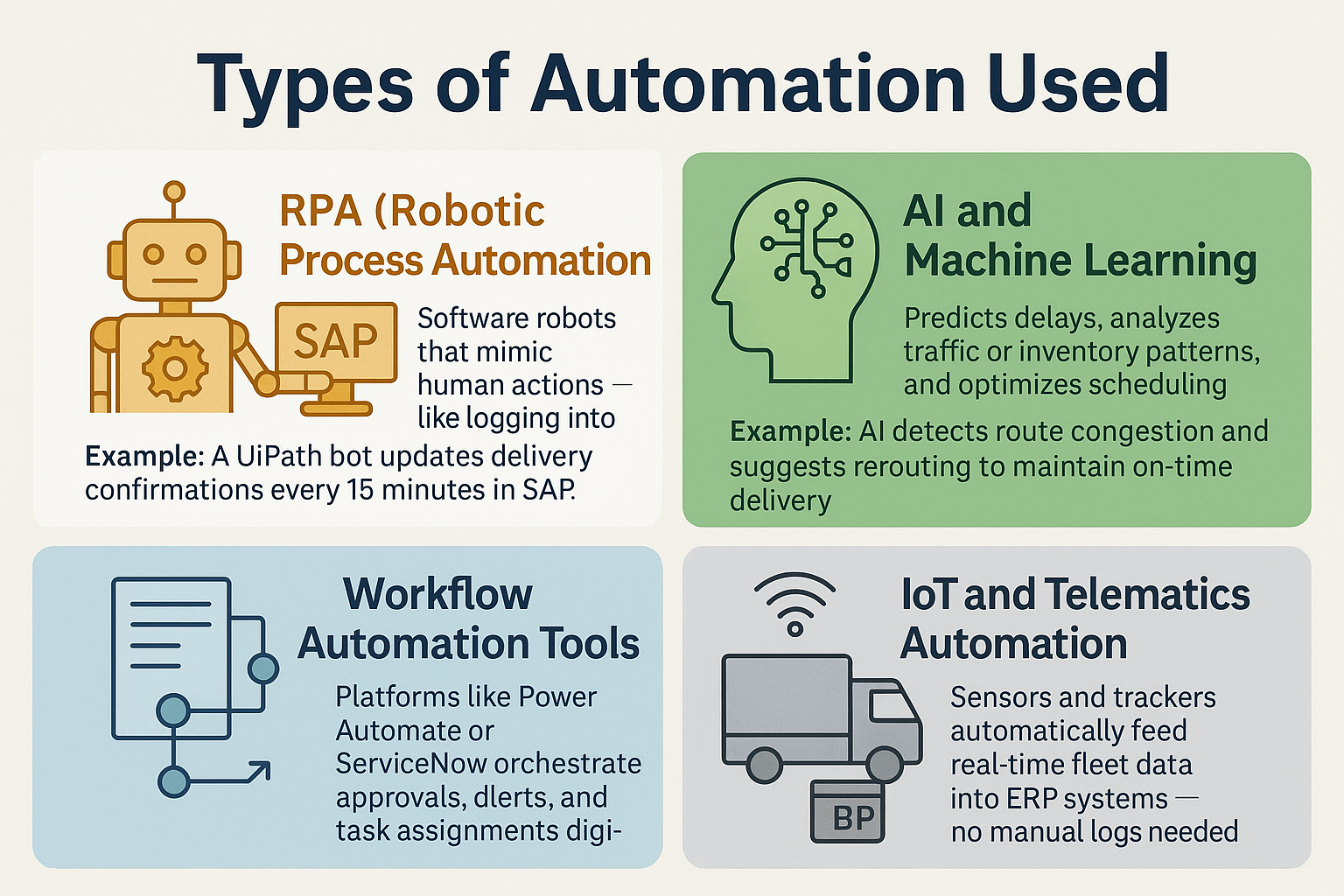
RPA (Robotic Process Automation):
Software robots that mimic human actions — like logging into SAP, entering data, and generating reports automatically.
Example: A UiPath bot updates delivery confirmations every 15 minutes in SAP.
AI and Machine Learning:
Predicts delays, analyzes traffic or inventory patterns, and optimizes scheduling.
Example: AI detects route congestion and suggests rerouting to maintain on-time delivery.
Workflow Automation Tools:
Platforms like Power Automate or ServiceNow orchestrate approvals, alerts, and task assignments digitally.
IoT and Telematics Automation:
Sensors and trackers automatically feed real-time fleet data into ERP systems — no manual logs needed.
When customer orders are received, RPA bots automatically generate work orders, assign drivers, and schedule dispatches — all within seconds.
No waiting for manual approvals or data entry.
Result:
Delivery planning starts sooner
Orders move from “booked” to “in-transit” faster
Dispatch accuracy improves
In a traditional setup, information flows slowly between systems — ERP, TMS, CRM, and warehouse tools often don’t talk to each other.
With automation, data is synchronized instantly:
When a driver completes a trip, SAP updates automatically.
When a customer updates an order, the dispatch schedule adjusts in real time.
Result:
Reduced miscommunication
Faster response to changing delivery conditions
Proactive issue resolution
Manual entry errors cause invoice mismatches and POD (Proof of Delivery) delays. Automation ensures every record is consistent and verified across systems.
Example:
A UiPath bot checks delivery confirmation emails, extracts key data, and updates SAP billing automatically.
Result:
Fewer billing disputes
Shorter payment cycles
Improved customer satisfaction
AI can analyze route patterns, driver schedules, and traffic data to predict delivery delays before they occur.
Example:
If a truck is stuck in traffic or delayed at a checkpoint, the system automatically alerts the customer and reroutes the next delivery.
Result:
On-time delivery percentage improves by up to 25%
Operations teams can proactively manage issues instead of reacting late
Automation tools generate daily and weekly reports for fleet performance, delivery timelines, and route efficiency — without human effort.
This helps leadership track:
Average delivery time per driver
Route delays and root causes
Vehicle utilization rates
Result:
Decision-making becomes data-driven and immediate.
Automation isn’t just about trucks or deliveries — it’s about freeing people from mundane back-office work that slows down operations.
RPA bots handle all repetitive SAP entries:
Work order creation
Material master updates
Inventory adjustments
Result: Admin staff can focus on process improvement, not paperwork.
Instead of endless email loops, automation tools route tasks automatically for approval.
For example, if a vehicle needs urgent maintenance, a digital workflow notifies the manager instantly.
Result: Faster decision-making and fewer communication breakdowns.
Automation ensures every shipment, delivery, and invoice is traceable. Compliance reports are created automatically — no more manual tracking.
Result: Reduced compliance risk, stress-free audits, and transparency across departments.
When teams aren’t buried in Excel sheets or SAP forms, they can focus on higher-value work — fleet optimization, customer service, or analytics.
Result: Happier, more engaged employees who add strategic value to the business.
A leading trucking firm deployed UiPath robots for:
Work order creation in SAP
Fuel and route data updates
Invoice validation
Impact:
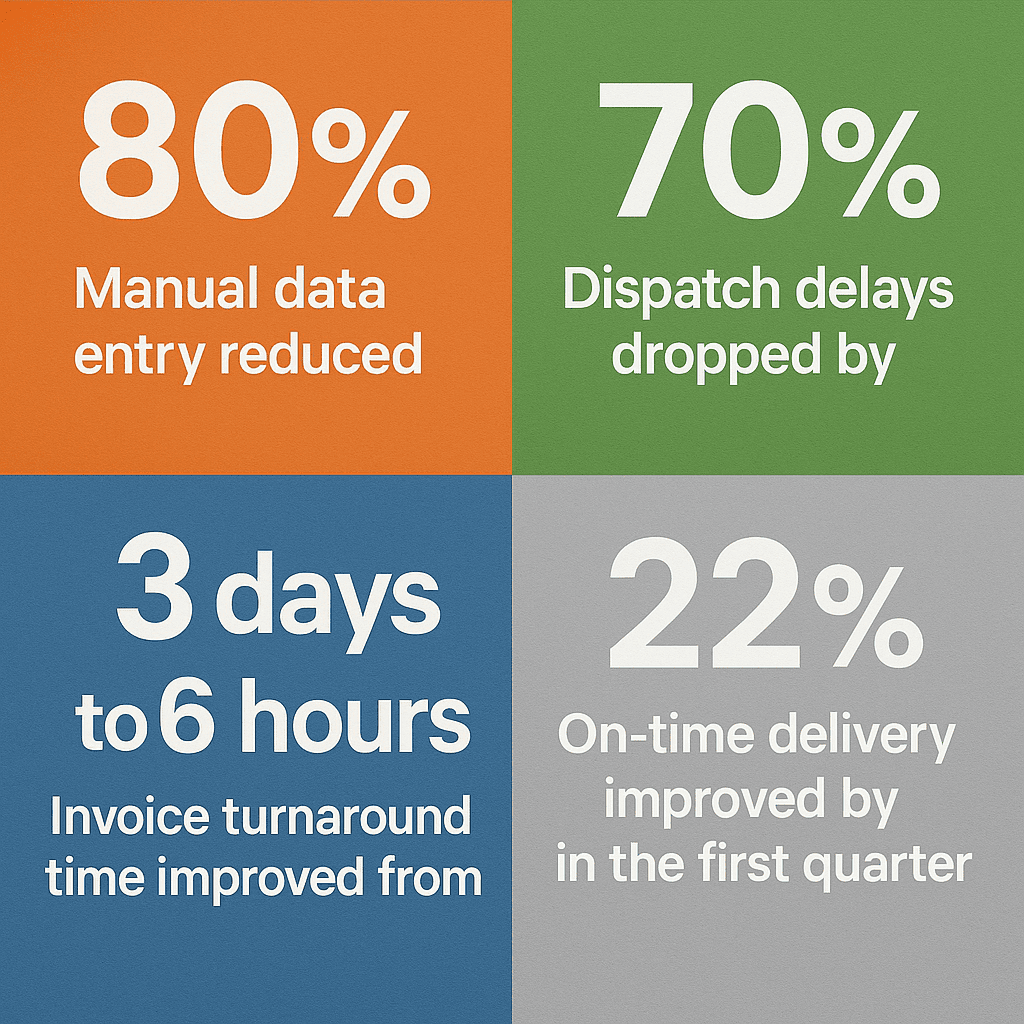
Manual data entry reduced by 80%
Dispatch delays dropped by 70%
Invoice turnaround time improved from 3 days to 6 hours
On-time delivery improved by 22% in the first quarter
This real-world transformation shows how even modest automation can create massive operational gains.
| Benefit | Automation Impact |
|---|---|
| Faster Dispatch | Auto-generated work orders |
| Real-Time Data Accuracy | No human lag or input errors |
| Fewer Delays | Predictive insights and auto-routing |
| Less Paperwork | Bots handle repetitive admin work |
| Happier Employees | Focus on problem-solving, not typing |
| Improved Cash Flow | Faster invoice and billing accuracy |
The future of logistics operations is collaboration between people and intelligent automation.
Humans bring expertise and decision-making, while bots handle the repetitive grunt work.
Together, they form a “digital workforce” that’s fast, reliable, and always connected.
As more trucking and manufacturing companies adopt AI, RPA, and data automation, we’ll see an industry that’s:
100% data-driven
0% paper-based
And consistently on-time
Automation is no longer optional — it’s the backbone of modern logistics and production operations.
By using tools like UiPath, Power Automate, or AI-driven SAP integrations, companies can dramatically improve on-time delivery, reduce administrative overload, and enhance customer trust.
Whether you’re a trucking company, manufacturer, or logistics provider, the message is clear:
➡️ Automate the routine. Accelerate the delivery. Elevate the business.
Headquarter: United States
255 Great Valley Parkway,
Suite 100, Malvern, PA-19355
Discover how AI, Automation, RPA, and ERP can revolutionize your business.