
The construction industry operates under tight margins, complex project schedules, multi-vendor dependencies, and heavy compliance requirements. Yet many construction companies still rely on manual, spreadsheet-driven, and disconnected processes across procurement, inventory, finance, and project controls.
The result?
Cost overruns, delayed projects, poor visibility, compliance risks, and cash-flow challenges.
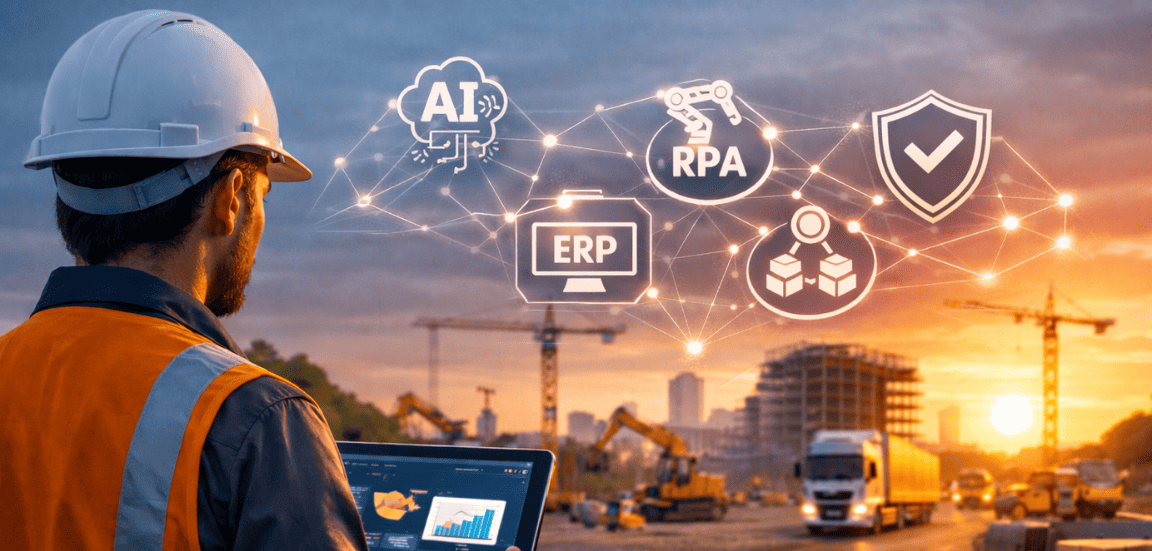
The good news is that most construction companies can automate 60–70% of their project operations and back-office workflows within 90 days using:
AI for document processing, forecasting, and anomaly detection
RPA (Robotic Process Automation) for repetitive, rule-based system tasks
ERP integration for financial, operational, and project-level control
👉 No core ERP or project management system replacement required.
Below is the construction automation use cases delivering the fastest ROI today.
Traditional automation focuses only on fixed rules.
Modern construction automation combines:
AI – to read drawings, invoices, BOQs, contracts, delivery notes, and compliance documents
RPA – to execute repetitive actions across ERP, project management, procurement, and finance systems
ERP integration – to maintain real-time financial control and project governance
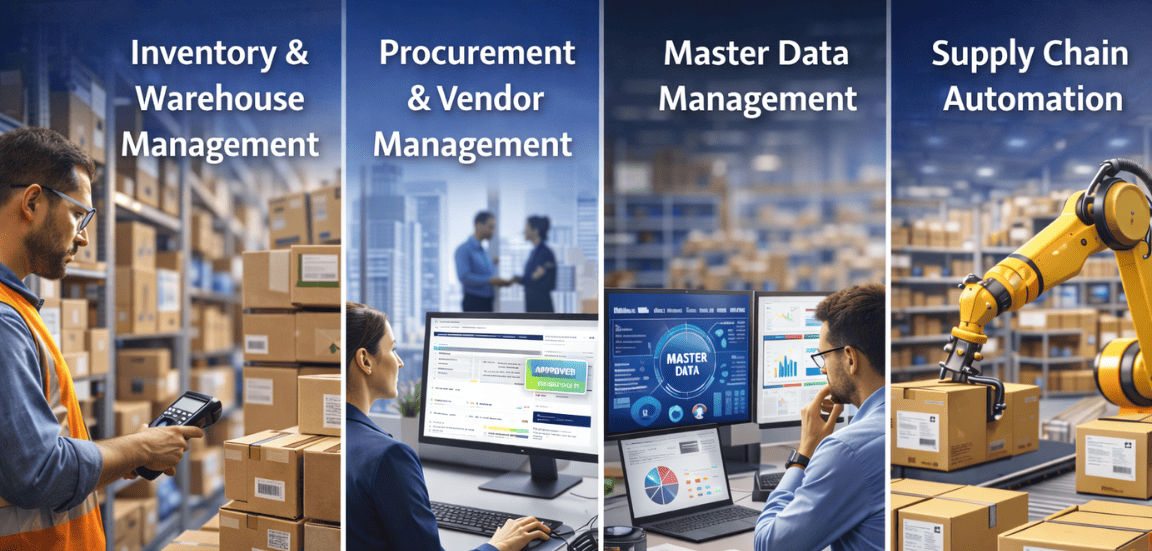
This combination enables end-to-end automation across project operations, from procurement and inventory to billing, payroll, compliance, and supply chain management.
Manual challenge:
Manual RFQs, vendor comparisons, PO creation, approvals, and follow-ups across multiple projects.
AI & RPA solution:
AI reads RFQs, quotations, and contracts
Automated vendor comparison and compliance checks
RPA creates POs and updates ERP
Automated approval workflows and vendor communication
Business impact:
Faster procurement cycles
Better vendor pricing and compliance
Reduced project delays
Improved spend visibility
Manual challenge:
Lack of real-time visibility into material stock across sites and warehouses, leading to shortages or overstocking.
Automation solution:
AI-driven demand forecasting by project phase
Automated stock updates from GRNs and issue slips
RPA syncs site inventory with ERP
Auto-replenishment triggers
Business impact:
Reduced material shortages
Lower carrying costs
Fewer site delays
Improved warehouse utilization
Manual challenge:
Processing supplier invoices, subcontractor bills, retention amounts, and tax deductions manually.
AI & RPA solution:
AI extracts invoice data (PDFs, scans, emails)
Validation against PO, GRN, contracts, and BOQs
Automated approvals and ERP posting
Scheduled payment processing
Business impact:
70–80% faster invoice processing
Fewer disputes and overpayments
Better vendor relationships
Improved cash-flow planning
Manual challenge:
Duplicate vendors, inconsistent material codes, incorrect tax rules, and outdated pricing.
Automation solution:
AI detects duplicates and data anomalies
Automated validation of tax, banking, and compliance data
Centralized ERP master data synchronization
Workflow-based approvals for data changes
Business impact:
Clean and reliable ERP data
Reduced payment and posting errors
Accurate project cost reporting
Lower compliance risk
Manual challenge:
Re-entering data from site systems, procurement tools, and spreadsheets into ERP.
RPA solution:
Bots transfer data across systems
Automated cost reconciliations
Exception handling and audit trails
Business impact:
60% reduction in accounting effort
Faster project cost close
Higher data accuracy
Manual challenge:
Delayed billing due to missing approvals, milestone tracking issues, or documentation gaps.
Automation solution:
AI monitors milestone completion
Auto-generation of invoices
ERP posting and customer submission
Business impact:
Faster billing cycles
Improved working capital
Reduced revenue leakage
Manual challenge:
Tracking subcontractor work progress, deductions, and retention releases manually.
Automation solution:
AI validates work completion against contracts
Automated retention calculations
RPA updates ERP and payment schedules
Business impact:
Fewer disputes
Accurate subcontractor settlements
Improved compliance
Manual challenge:
Complex labor rates, overtime rules, site attendance, and compliance tracking.
Automation solution:
AI calculates wages from attendance and work logs
RPA prepares payroll entries
ERP posting and compliance reporting
Business impact:
Accurate payroll
Reduced disputes
Improved workforce trust
Manual challenge:
Manual compilation of safety, tax, labor, and statutory compliance reports.
Automation solution:
AI aggregates data across systems
Automated report generation
Digital document storage and audit trails
Business impact:
Faster audits
Reduced regulatory risk
Improved governance
Manual challenge:
Limited visibility into supplier deliveries, logistics delays, and site-level material movement.
Automation solution:
AI predicts supply risks and delays
Automated delivery tracking and alerts
ERP-integrated supply chain dashboards
Business impact:
Reduced site downtime
Better supplier coordination
Improved project timelines
| Phase | Duration |
|---|---|
| Process discovery | 1–2 weeks |
| Automation design | 2 weeks |
| Development | 4–6 weeks |
| Testing & go-live | 2–3 weeks |
60–70% reduction in manual back-office work
30–50% faster billing
40% fewer processing errors
Improved data quality
Lower operating costs
Better compliance
Scalable growth
Selecting the right automation partner is critical for construction companies aiming to modernize project operations without disrupting live projects.
Beyond technical capabilities, successful partners bring deep construction domain knowledge, ERP expertise, data governance frameworks, and long-term support models.
Leading construction automation partners focus on operational transformation, not just task automation. They help organizations redesign workflows, standardize master data, and embed intelligence across procurement, inventory, finance, payroll, and supply chain operations.
To achieve real outcomes, construction companies should partner with providers that offer:
End-to-end construction process automation (AI, RPA, workflow orchestration, analytics)
ERP integration for project costing, procurement, inventory, and finance
Process discovery, redesign, and optimization across site and head-office teams
Seamless integration with ERP, project management tools, procurement platforms, and supplier portals
Ongoing monitoring, governance, and optimization
The result is a connected, intelligent construction operating model—where automation improves cost control, project predictability, compliance, and decision-making across the entire project lifecycle.
Headquarter: United States
255 Great Valley Parkway,
Suite 100, Malvern, PA-19355
Discover how AI, Automation, RPA, and ERP can revolutionize your business.