

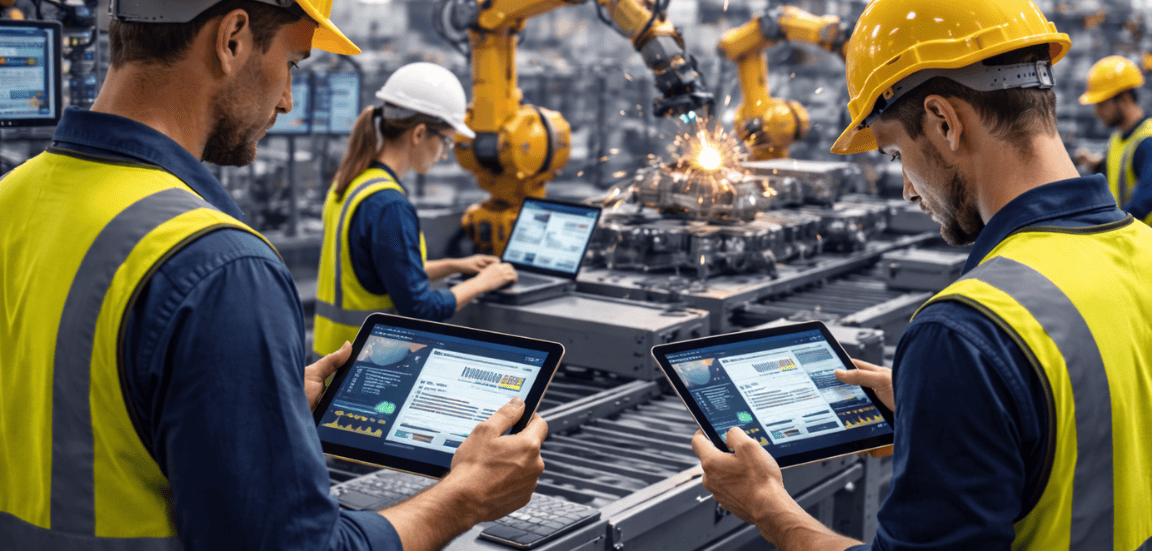
Manufacturing companies today face rising input costs, supply chain volatility, labor shortages, and increasing pressure to improve efficiency without disrupting production.
Yet many factories still rely on manual, siloed, and spreadsheet-driven processes across ERP, warehouses, procurement, finance, and order management.
Production delays
Inventory mismatches
Cash-flow inefficiencies
High operational costs
Limited real-time visibility
The good news:
Manufacturers can automate 60–75% of factory and back-office operations within 90 days using a smart combination of:
AI for document processing, forecasting, and anomaly detection
RPA (Robotic Process Automation) for repetitive system-driven tasks
ERP integration for end-to-end operational and financial control
👉 No rip-and-replace of existing ERP or MES systems required.
Below are the manufacturing automation use cases delivering the fastest and most measurable ROI.
Traditional factory automation focuses mainly on machines and production lines.
Modern manufacturing automation extends beyond the shop floor and connects:
Planning
Procurement
Inventory
Order management
Finance
Compliance
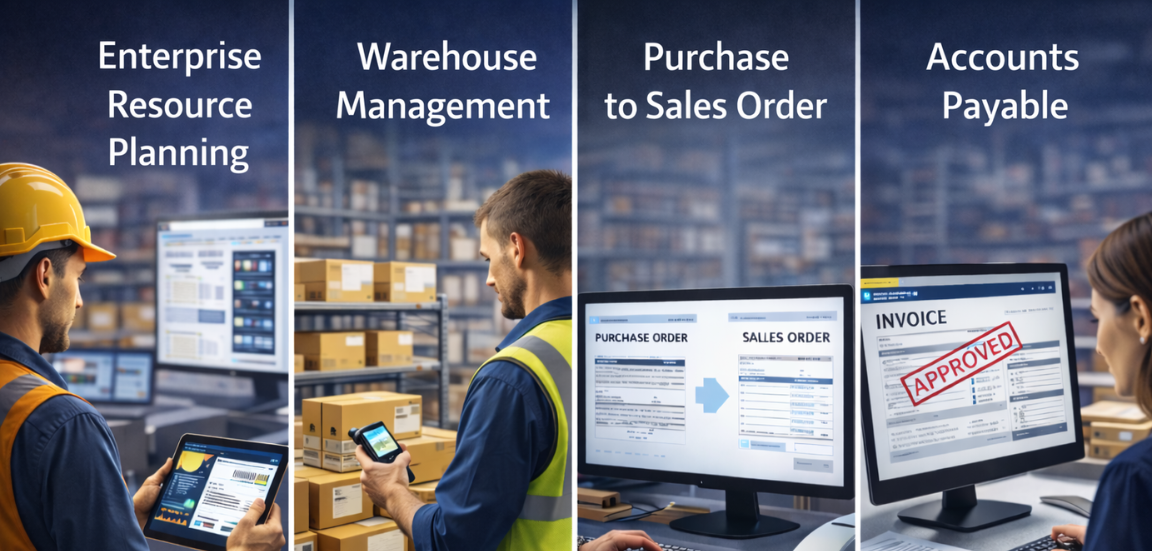
By combining AI + RPA + ERP, manufacturers achieve connected, intelligent factory operations—from purchase order to sales order, inventory to invoicing, and production to payments.
What’s automated:
Data entry across ERP modules
Production order updates
Cost postings and reconciliations
Impact:
Single source of truth
Faster period close
Reduced manual errors
What’s automated:
Goods receipt and issue
Bin-level inventory tracking
Barcode and RFID-based updates
Stock synchronization with ERP
Impact:
Real-time inventory visibility
Fewer stockouts and excess inventory
Faster material movement
What’s automated:
Conversion of customer demand into production and sales orders
Validation against pricing, contracts, and availability
Order creation in ERP and connected systems
Impact:
Faster order processing
Reduced order entry errors
Improved customer fulfillment timelines
What’s automated:
Invoice data capture
2-way / 3-way matching (PO, GRN, Invoice)
Approval workflows and ERP posting
Scheduled payments
Impact:
70–80% faster invoice processing
Fewer disputes and duplicate payments
Improved vendor relationships
AI-driven demand forecasting
Automated production plan updates
Capacity and material alignment
Result: Better production efficiency and fewer bottlenecks
Automated reorder point monitoring
Predictive demand signals
ERP-driven replenishment
Result: Optimized inventory and lower carrying costs
AI-based defect detection
Automated quality reporting
Non-conformance tracking
Result: Improved product quality and reduced rework
Predictive maintenance alerts
Automated work orders
Asset cost and depreciation tracking
Result: Reduced downtime and extended equipment life
Automated regulatory reporting
Digital audit trails
Centralized documentation
Result: Faster audits and lower compliance risk
Automated reconciliations
Real-time cost tracking
Faster month-end and year-end close
Result: Improved financial visibility and control
| Phase | Duration |
|---|---|
| Process discovery | 1–2 weeks |
| Automation design | 2 weeks |
| Development | 4–6 weeks |
| Testing & go-live | 2–3 weeks |
60–70% reduction in manual back-office work
30–50% faster billing
40% fewer processing errors
Improved data quality
Lower operating costs
Better compliance
Scalable growth
Successful manufacturing automation is not about isolated bots—it’s about end-to-end operational transformation.
The right partner helps manufacturers:
Redesign workflows
Standardize ERP and master data
Integrate shop-floor, warehouse, and finance systems
Embed intelligence across operations
End-to-end manufacturing automation (AI, RPA, workflows, analytics)
Deep ERP and manufacturing domain expertise
Seamless integration with ERP, MES, WMS, and supplier systems
Ongoing monitoring, governance, and optimization
The outcome is a connected, intelligent manufacturing operating model—where automation improves efficiency, cost control, compliance, and decision-making across the entire factory ecosystem.
Headquarter: United States
255 Great Valley Parkway,
Suite 100, Malvern, PA-19355
Discover how AI, Automation, RPA, and ERP can revolutionize your business.