
The trucking industry operates on thin margins, tight delivery schedules, and complex financial workflows. Yet many companies still depend on manual back-office processes for invoicing, accounts payable, payroll, compliance, and data management.
The result?
High costs, slow processing, frequent errors, and limited visibility.
The good news is that most trucking companies can automate 60–70% of their back-office operations in just 90 days using:
AI in trucking companies for document processing and forecasting
RPA (Robotic Process Automation) for repetitive system tasks
ERP integration for financial and operational control
No core system replacement required.
Below are the 10 trucking processes that deliver the fastest ROI.
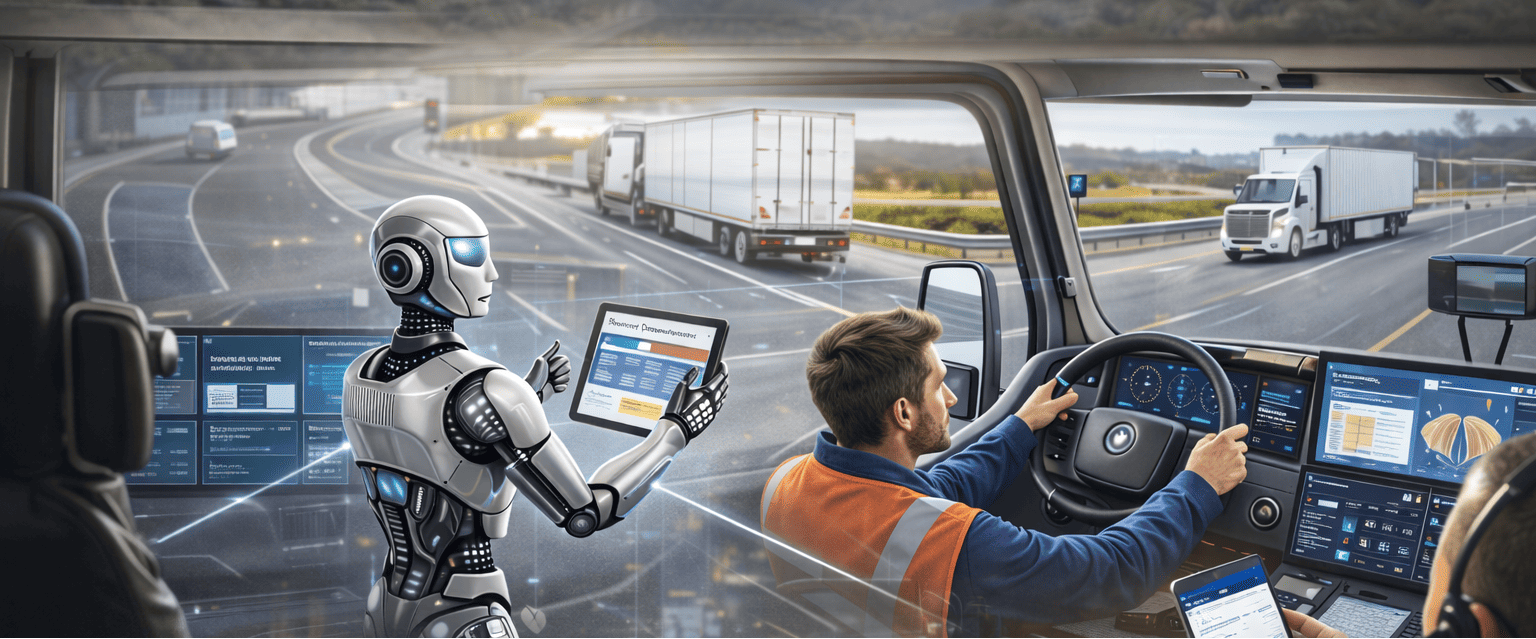
Traditional automation focuses only on rules.
Modern automation combines:
AI – to read documents, detect anomalies, and forecast demand
RPA – to execute repetitive system tasks
ERP integration – to ensure financial and operational control
This combination allows trucking companies to automate end-to-end workflows across dispatch, payroll, billing, compliance, and supply chain operations.
Manual challenge:
Processing thousands of carrier invoices, fuel bills, toll charges, and vendor payments manually.
AI & RPA solution:
AI extracts data from invoices (PDF, email, portals)
RPA validates against load, rate confirmation, and contracts
Automated approvals and posting into ERP
Scheduled payment execution
Business impact:
70–80% faster invoice processing
Fewer overpayments and duplicates
Improved carrier relationships
Better cash-flow planning
Manual challenge:
Duplicate records, outdated vendor details, inconsistent pricing rules, incorrect tax information.
Automation solution:
AI detects duplicates and anomalies
Automated validation of banking, tax, and compliance data
ERP master data synchronization
Workflow-based approvals for changes
Business impact:
Clean ERP data
Reduced payment failures
Accurate reporting
Lower compliance risk
Manual challenge:
Re-entering data from TMS, fuel systems, ELD, and portals into ERP.
RPA solution:
Bots move data between systems
Automated reconciliations
Error detection
Audit trail creation
Business impact:
60% less accounting effort
Faster month-end close
Higher data accuracy
Manual challenge:
Dispatch teams entering shipment details manually.
AI & RPA solution:
AI reads rate confirmations
RPA creates orders in TMS & ERP
Validation against contracts
Business impact:
Faster dispatching
Fewer booking errors
Manual challenge:
Missing or unreadable PODs delaying invoicing.
Automation solution:
AI quality checks
Auto-upload to shipment records
Trigger billing
Business impact:
Faster billing
Reduced disputes
Manual challenge:
Delayed invoices due to missing documentation.
Automation solution:
AI detects POD availability
Auto-generate invoices
ERP posting and submission
Business impact:
Shorter order-to-cash cycle
Improved working capital
Manual challenge:
Complex pay structures and compliance rules.
Automation solution:
AI calculates earnings from trip data
RPA prepares payroll
ERP posting
Business impact:
Accurate pay
Reduced payroll disputes
Manual challenge:
Collecting data across systems.
Automation solution:
AI aggregation
Automated reports
Digital documentation
Business impact:
Faster audits
Lower regulatory risk
Manual challenge:
Manual reconciliation of fuel cards.
AI solution:
Anomaly detection
Automated matching
ERP updates
Business impact:
Fraud prevention
Cost transparency
Manual challenge:
Tracking parts, tires, and maintenance stock.
Automation solution:
AI demand forecasting
Auto-replenishment
ERP inventory integration
Business impact:
Reduced downtime
Lower inventory costs
| Phase | Duration |
|---|---|
| Process discovery | 1–2 weeks |
| Automation design | 2 weeks |
| Development | 4–6 weeks |
| Testing & go-live | 2–3 weeks |
60–70% reduction in manual back-office work
30–50% faster billing
40% fewer processing errors
Improved data quality
Lower operating costs
Better compliance
Scalable growth
Selecting the right automation partner is critical for trucking and logistics companies aiming to achieve scalable, reliable, and enterprise-grade process automation.
Beyond technical skills, factors such as industry knowledge, TMS and ERP experience, data management capabilities, and long-term support models play a major role in determining automation success.
Leading trucking automation partners focus on operational transformation, not just task-level automation. They help organizations redesign workflows, standardize data, and embed intelligence across dispatch, accounting, compliance, and supply chain operations—ensuring automation delivers measurable and lasting business value.
To achieve real outcomes, trucking companies should partner with providers that offer:
End-to-end trucking process automation services (RPA, AI document processing, workflow orchestration, and reporting)
AI consulting and implementation for load processing, invoicing, compliance, and demand forecasting
Process discovery, redesign, and optimization across dispatch, finance, payroll, and compliance teams
Seamless integration with TMS, ERP, fuel systems, ELD platforms, and customer portals
Ongoing support, monitoring, and governance for automated workflows
Leading trucking automation partners help organizations move beyond isolated bots and toward a connected, intelligent digital operating model—where automation improves cost control, operational accuracy, regulatory compliance, customer satisfaction, and decision-making across the logistics network.



Headquarter: United States
255 Great Valley Parkway,
Suite 100, Malvern, PA-19355
Discover how AI, Automation, RPA, and ERP can revolutionize your business.

