
Manual processes are costing more than you think — in time, money, accuracy, customer trust, and growth opportunities. In today’s digital-first economy, businesses that still rely heavily on spreadsheets, email chains, and human-dependent workflows are quietly bleeding resources while their competitors accelerate using AI and automation.
AI and automation are no longer “nice to have” technologies. They are strategic necessities for survival, scalability, and long-term profitability.
This article explains why.

Manual operations may look affordable on the surface, but they carry invisible expenses that grow over time. Every delay, correction, or compliance failure adds friction to your operations and reduces profitability. These inefficiencies quietly compound, creating long-term financial and operational damage.
Organizations that fail to modernize often underestimate how much revenue is lost through process delays, customer churn, and employee disengagement. This is why many enterprises now turn to business automation services and AI-driven process optimization to regain control of operational costs.
At first glance, manual operations appear cheaper. There’s no new software to purchase, no implementation project, and no training budget. But this perception is misleading.
Manual processes introduce costs that rarely appear on financial statements:
Rework due to human errors
Delays in approvals and handoffs
Lost revenue from slow response times
High employee turnover from repetitive work
Compliance risks and audit failures
Poor customer experience
A single error in invoicing, payroll, or inventory can trigger a chain reaction of corrections, customer dissatisfaction, and reputational damage. Over time, these small inefficiencies compound into major financial losses.
Automation eliminates this silent drain.

In modern markets, speed determines who wins and who gets left behind. Customers expect instant service, executives demand real-time insights, and partners require fast integration. Businesses that cannot move quickly struggle to remain relevant.
AI-powered workflow automation and RPA services enable organizations to shorten cycle times dramatically while maintaining accuracy and compliance. Faster operations directly translate into higher revenue and stronger customer loyalty.
Customers expect instant responses. Partners demand faster onboarding. Leadership expects real-time reporting.
Manual operations cannot keep pace with modern expectations.
AI-powered automation enables:
24/7 business operations
Real-time data processing
Instant document validation
Automated decision routing
Faster order-to-cash and procure-to-pay cycles
Organizations using enterprise-grade RPA services consistently reduce processing time by 60–90% across finance, HR, supply chain, customer service, and IT operations.
Speed directly impacts revenue.

Data accuracy is the foundation of every successful business decision. Even small inconsistencies can disrupt financial reporting, regulatory compliance, and customer trust. Manual systems simply cannot deliver the precision modern enterprises require.
Intelligent automation solutions powered by machine learning and AI services significantly reduce data inconsistencies while ensuring standardized execution across departments and locations.
Human beings make mistakes — especially when repeating the same tasks hundreds of times per day.
Automation systems do not get tired. They do not forget steps. They do not misread fields.
AI models enhance this further by detecting anomalies, duplicate entries, fraud patterns, and data inconsistencies that humans often miss.
Companies adopting intelligent automation experience:
99%+ process accuracy
Lower compliance violations
Cleaner ERP and CRM data
Reduced audit risks
For regulated industries such as healthcare, banking, insurance, and manufacturing, accuracy is not just valuable — it is mandatory.

Traditional automation executes predefined steps, but artificial intelligence introduces reasoning and adaptability. This shift allows systems to analyze information, understand context, and improve performance over time.
Businesses investing in AI consulting services and intelligent automation platforms can automate complex decision-making processes that once required human judgment.
Traditional automation follows rules. AI-driven automation understands context.
Modern AI services include:
Natural language processing for documents and emails
Computer vision for invoices and forms
Predictive analytics for demand forecasting
Conversational AI for customer support
Machine learning for fraud detection
This allows businesses to automate complex, judgment-based workflows that were previously impossible to handle without human intervention.
The result is not just faster work — it is smarter work.
Market leaders differentiate themselves through digital maturity. Automation enables consistent service delivery, predictable costs, and scalable growth — all critical for staying ahead.
Companies leveraging AI automation services can adapt faster to market changes, regulatory updates, and customer expectations than traditional organizations.
| Companies Leveraging Automation | Companies Delaying Automation |
|---|---|
| Launch products faster | Experience rising operational costs |
| Serve customers better | Face shrinking profit margins |
| Scale operations without aggressive hiring | Struggle with inefficient manual processes |
| Adapt quickly to market changes | Respond slowly to customer and market demands |
| Maintain consistent service quality | Deliver inconsistent service experiences |
| Build high digital maturity and market leadership | Fall behind as digital laggards |
North America continues to dominate global enterprise automation adoption due to its strong technology ecosystem and mature enterprise infrastructure. Organizations actively invest in scalable and secure digital transformation strategies.
The rapid growth of AI services in North America is fueled by cloud computing, cybersecurity standards, and demand for data-driven decision-making.
North America has become the global hub for enterprise automation adoption.
Demand for AI services in North America continues to surge due to:
Strong cloud infrastructure
High labor costs driving automation ROI
Advanced regulatory requirements
Mature enterprise software ecosystems
Large-scale digital transformation initiatives
Organizations across the United States and Canada are actively investing in:
RPA services
Intelligent process automation
AI consulting n- Machine learning platforms
Enterprise workflow automation
From startups to Fortune 500 companies, automation is now a board-level priority.
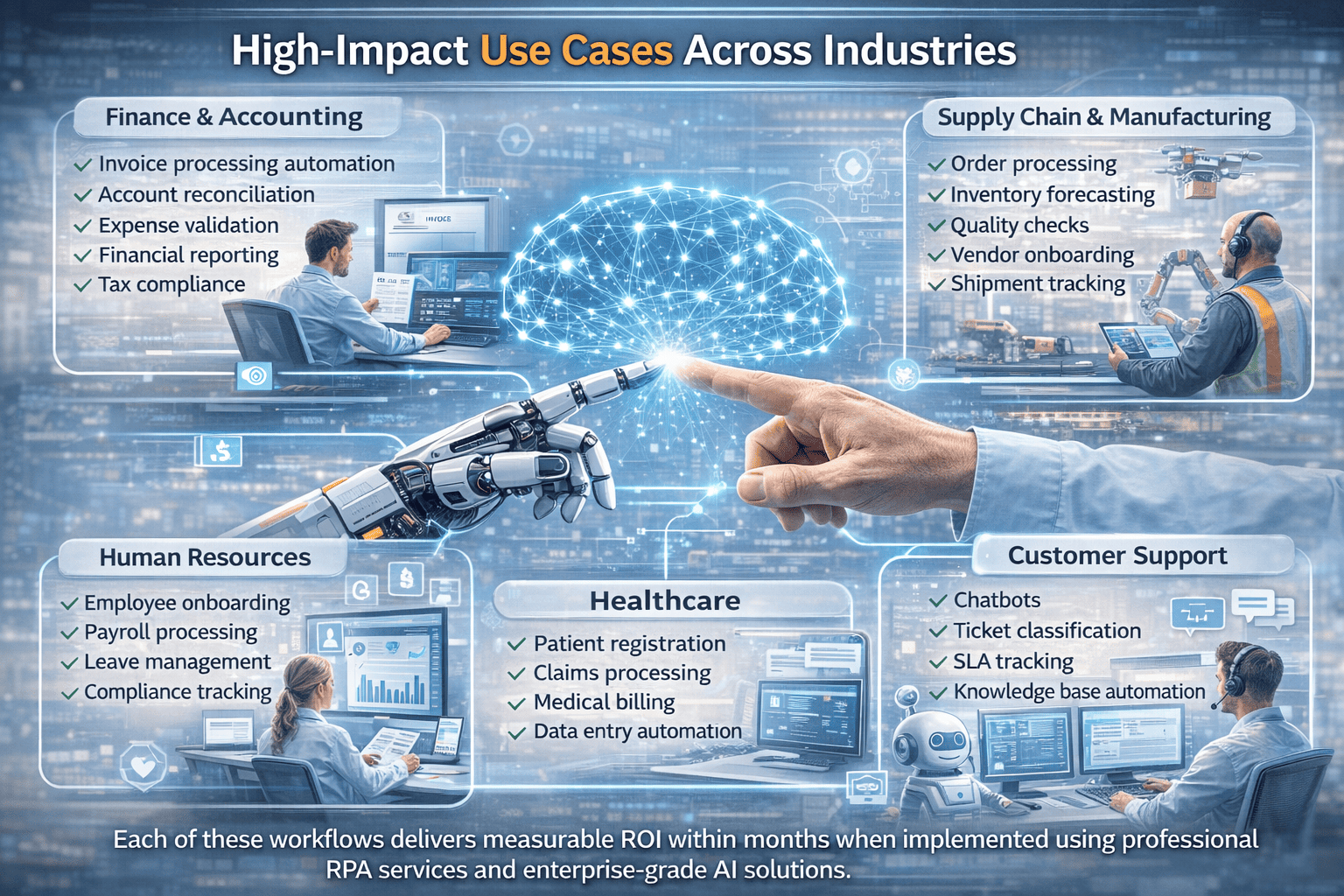
Automation delivers measurable value across every major industry by reducing operational friction and enabling data-driven execution. From manufacturing floors to financial back offices, AI-powered automation solutions continue to redefine productivity standards.
Enterprises increasingly adopt industry-specific automation services to achieve faster ROI and maintain competitive advantage.
Selecting the right technology partner is critical for sustainable automation success. Experience, domain knowledge, and post-implementation support significantly influence project outcomes.
Leading providers of AI and RPA services focus on long-term business transformation rather than short-term automation deployment.
To achieve real business outcomes, companies must partner with experienced providers offering:
End-to-end RPA services
AI consulting and implementation
Process discovery and optimization
ERP and CRM integration
Ongoing support and governance
Leading AI services providers in North America focus on delivering business value



Headquarter: United States
255 Great Valley Parkway,
Suite 100, Malvern, PA-19355
Discover how AI, Automation, RPA, and ERP can revolutionize your business.

